Start with the space around your face
A neck scarf and a piece of jewelry can occupy the same small area, so begin by looking at the whole space from collarbone to ears. Is the scarf tied close to the throat, or does it fall loosely over the chest? Is its print bold, or is it nearly the same color as your top? These details help you choose jewelry more reliably than a rule about what must or must not be worn together.
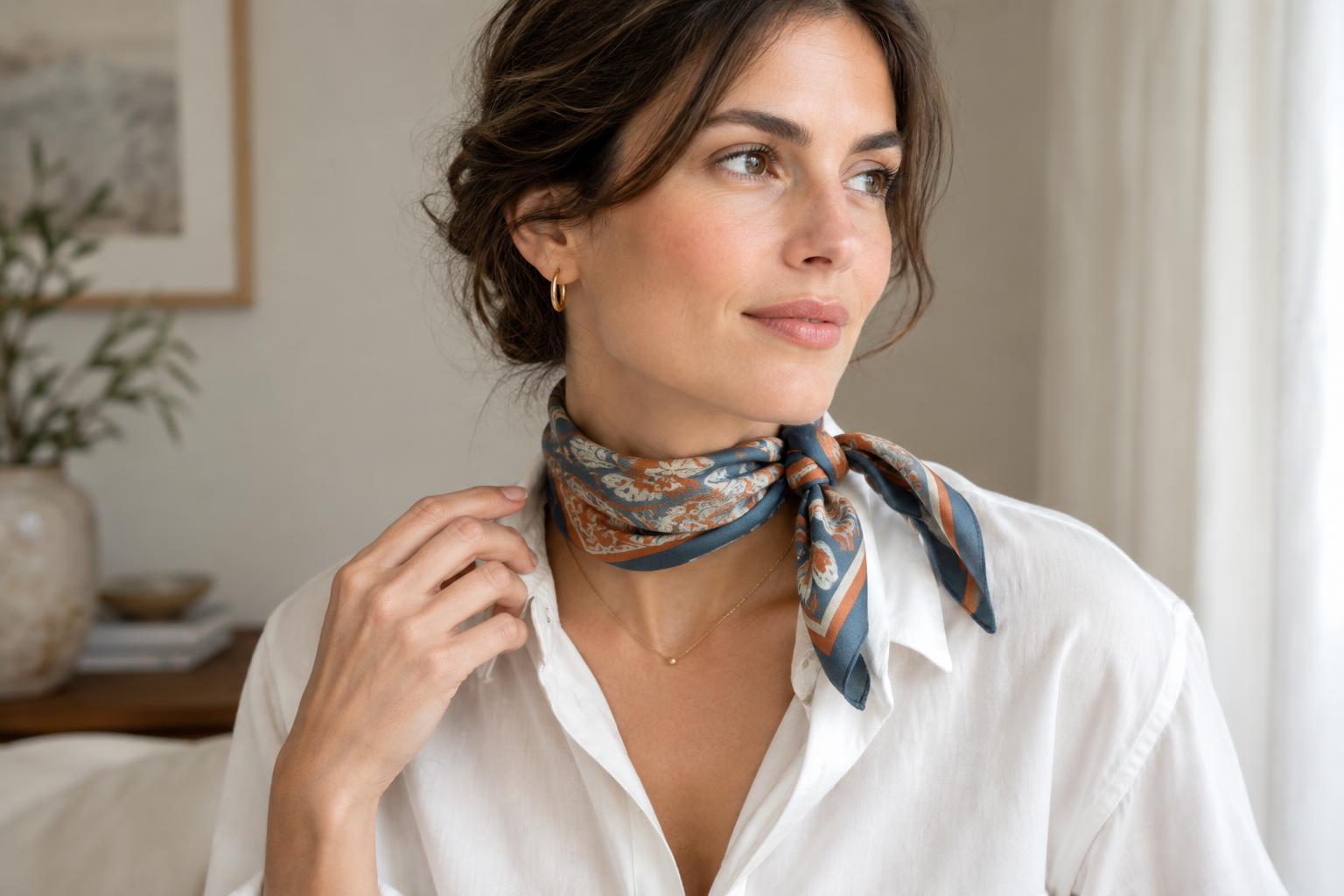
A close knot already draws attention upward. Try it first with small hoops, studs or slim drop earrings, and leave the neck bare. If the scarf is narrow and tied loosely, there may be room for a delicate necklace. The goal is not to make every accessory subtle; it is to decide which one should be noticed first.
Let the knot determine the necklace
A short scarf tied at the side creates a point of interest near the neck. A necklace that ends at the same height may tangle visually with the knot, even when the pieces never touch. You can skip the necklace, choose a chain that sits clearly below the knot, or move the knot slightly farther to one side. Check the result while standing naturally: a combination that looks separate when arranged by hand may overlap as you move.
With a scarf draped inside an open collar, a fine chain can sit against the skin while the fabric forms a frame around it. Keep the pendant small enough that it does not compete with the scarf ends. If you prefer a more substantial necklace, try wearing the scarf as a loose band at the neck and placing the necklace over a plain top, with visible space between the two. When that spacing is hard to maintain, removing one piece often makes the outfit feel more intentional.
Consider texture as well as position. A chain or setting with sharp edges can catch on silk or another delicate weave. If you notice friction, separate the pieces or choose smoother jewelry rather than repeatedly adjusting the fabric.
Choose earrings by scale, not just color
Earrings sit away from the scarf, which makes them an easy way to add jewelry without crowding the neckline. Their scale matters. A vivid print tied in a generous bow often needs little more than studs or modest hoops. A slim, solid-color scarf can hold its own beside longer earrings, particularly when the rest of the outfit is quiet.
Think about what is visible around your hair and collar. Statement earrings may be partly hidden by loose hair but prominent with hair tucked behind the ears. Likewise, a high collar, scarf knot and long earrings can create several competing shapes in one area. If that happens, try smaller earrings before changing the scarf. You may find that the outfit needs fewer elements, not different colors.
Matching can be gentle rather than exact. Earrings might echo one color in a printed scarf, pick up its warm or cool tone, or simply repeat the shape of another accessory. Neutral metal earrings can also give a patterned scarf space to be the main feature.
Use your neckline to create breathing room
A crewneck top gives a neck scarf a clean background, but it also puts the fabric near any short necklace. With this combination, earrings alone are a straightforward choice. If you want a necklace, test a longer chain that falls well below the scarf rather than one that disappears beneath its knot.
An open shirt or V-neck creates more visible space between neck and chest. That space can support a scarf and a fine pendant, provided they sit at distinct levels. A turtleneck does the opposite: it layers fabric behind the scarf and can make a necklace feel like one detail too many. In that case, earrings or a ring may provide all the contrast you want.
Look at the complete outfit before deciding it needs another accessory. Jacket lapels, shirt buttons and patterned fabric all add visual detail. A scarf with earrings may feel restrained against a plain knit, yet fully dressed beneath a structured jacket. Adjust for what you are actually wearing, not for the scarf in isolation.
Make the final check simple
Before leaving, look in a mirror from a few steps back. Notice where your eye goes first, then whether it can move comfortably to the other details. If the scarf, earrings and necklace all demand equal attention, remove one or reduce its scale. If the look feels too bare, add back a small piece with a clear purpose, such as studs that brighten the face or a pendant that fills an open neckline.
Finally, move your head and shoulders. Check whether earrings brush the scarf, a pendant slips under the knot, or a chain catches the fabric. A balanced combination should be comfortable as well as pleasing to look at. Once the pieces sit securely, leave them alone: a scarf’s charm often comes from looking easy to wear.