Start with the clothes you already wear
Before choosing a scarf, look at the coats, jackets, knitwear, and tops you reach for most often. These pieces will sit beside the scarf, so they offer a better guide than a color you like in isolation. Set out a few typical outfits and note the shades that repeat. You may find that your wardrobe leans toward navy and cream, for example, or toward black, grey, and warm brown.
Next, decide what you want the scarf to do. It can blend with your clothes, add a gentle lift, or become the most noticeable part of an outfit. If you usually wear several colors at once, a scarf in one of your recurring shades may be easiest to use. If your outfits are mostly neutral, a stronger color can bring variety while leaving the rest of your wardrobe unchanged. Neither approach is more stylish; the useful choice is the one you will want to wear.
Choose a relationship, not a perfect match
A scarf does not need to match a coat exactly. In fact, a small difference in shade can make an outfit feel more considered than two colors that almost, but not quite, match. Try pairing a dark garment with a lighter version of the same color, such as navy with soft blue. You can also connect colors through a shared mood: muted shades often sit comfortably together, while clear, bright shades can hold their own beside one another.
Think about contrast as well as color. A pale scarf against a dark coat will stand out even if both are quiet neutrals. A deep scarf against a deep coat will look more understated, though its texture or pattern may still add interest. If you want one scarf to work across several outfits, test it with both your lightest and darkest outer layers. That simple check can reveal whether it provides the variety you hoped for.
Consider how the color looks near your face
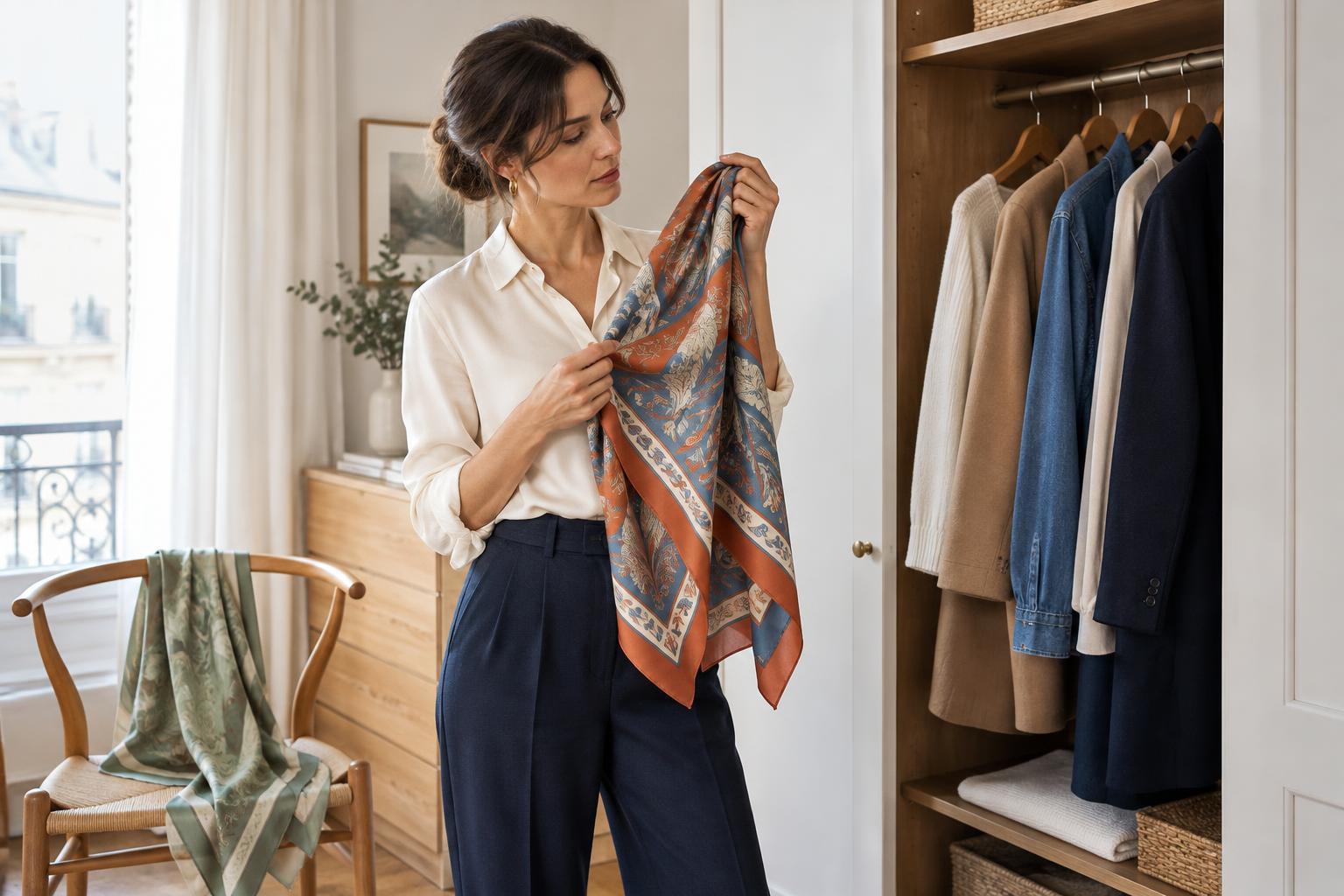
Scarves often frame the face, which makes their color feel different from the same shade on a bag or pair of shoes. Hold a possible scarf beneath your chin and look at it in natural daylight if you can. Notice whether you enjoy the overall effect, rather than trying to follow a rigid rule about which colors you are allowed to wear. Personal preference matters: a color that makes you feel comfortable is likely to get more use.
If you love a color but find it overwhelming right under your face, you do not have to rule it out. Try a smaller scarf, tie it lower at the neck, or wear it on a bag. A printed scarf offers another option: the favorite color can appear in small amounts alongside shades you already wear. How you style a scarf can be as important as the color itself.
Use prints to connect pieces across your wardrobe
A multicolored scarf can make choosing easier when its print includes two or three colors from your closet. One shade might echo your coat, another your knitwear, and a third add something new. You do not need to wear every color in the print at once. Repeating just one is enough to give the scarf a connection to the outfit.
Look at the overall impression of a print from a little distance. Tiny details may be beautiful up close, but the dominant background and largest shapes will have the strongest effect when the scarf is worn. Also consider scale. A bold print can enliven a plain coat; a quieter pattern may be easier to pair with striped or textured clothing. If you often wear prints, leaving some visual space between them, perhaps with a solid jacket, can help each one remain distinct.
Make the final choice with real outfits
Before buying, imagine at least three specific ways you would wear the scarf, using clothes you own rather than clothes you might buy later. For instance, could it work with your everyday coat, a simple shirt, and a weekend knit? If possible, compare it against those pieces in daylight. Colors can look different under shop lighting or on a screen, so allow for some uncertainty when judging a shade from a photograph.
Finally, consider whether the scarf suits the way you dress and care for your clothes. A delicate silk scarf may be a pleasure to wear, but it calls for attention to its care label and storage. A scarf you feel happy tying, carrying, and looking after has a better chance of becoming part of your routine. The best color is not necessarily the most versatile one on paper; it is the one that works with your wardrobe and makes you want to reach for it.