Start with what the scarf will actually show
Print scale describes the size of the visible elements in a pattern. A scarf dotted with tiny flowers has a small-scale print; one covered in broad shapes or oversized blooms has a large-scale print. Neither is inherently easier to wear. The useful question is how much of the design will be visible once the scarf is tied, draped, or folded.
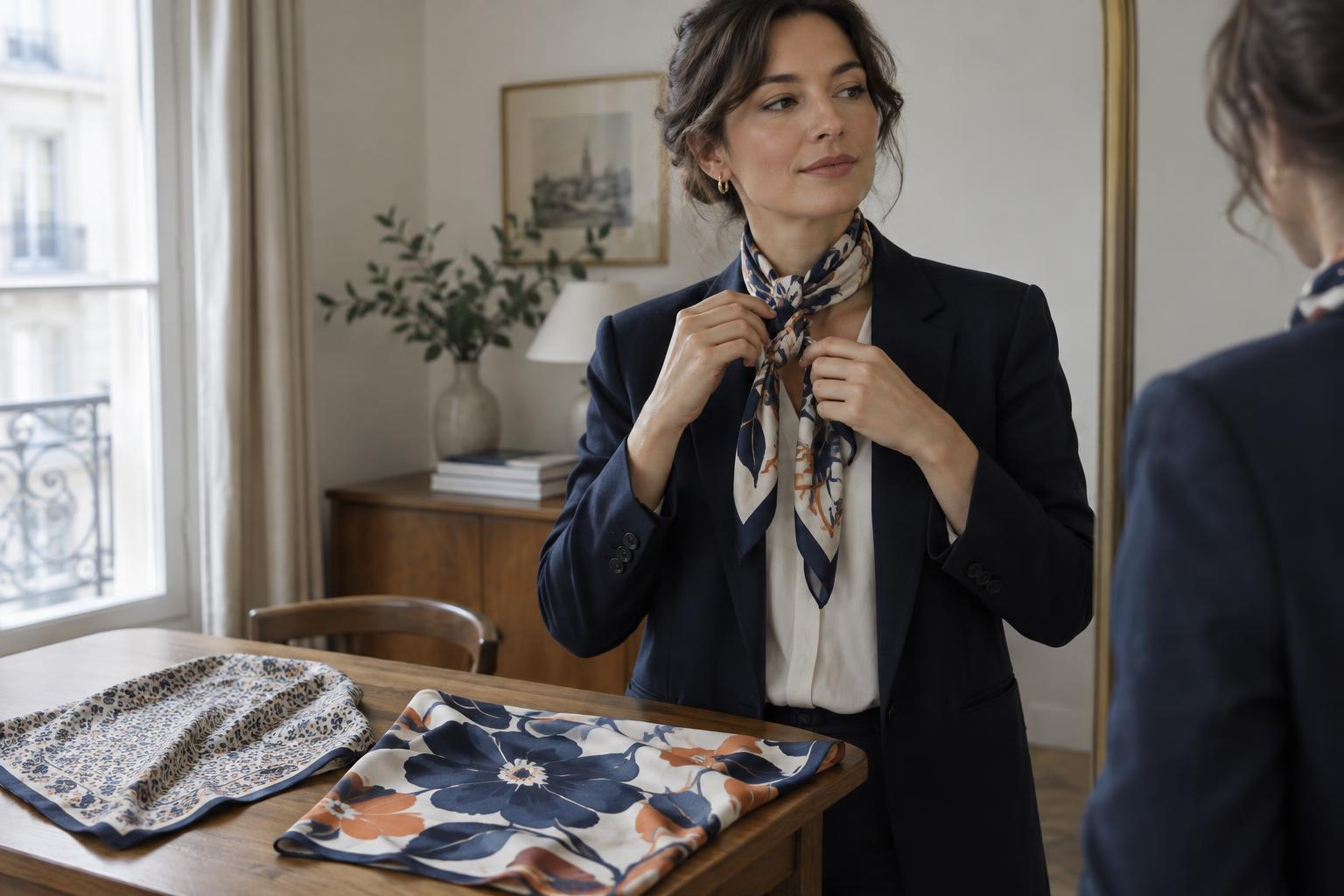
Before deciding whether a print feels too bold or too quiet, arrange the scarf as you plan to wear it. A large motif may disappear into the folds of a narrow neck knot, leaving only its background color and border on view. A small, repeated motif often remains recognizable after folding. Laid flat across the shoulders, however, the same scarf reveals more of its design and may have a much stronger presence.
Let the outfit set the starting point
A mostly solid outfit gives you room to choose any print scale. With a plain shirt, sweater, or coat, a large-scale scarf can provide a clear focal point. A smaller print adds texture without drawing as much attention. If you want the scarf to be noticed first, choose a pattern with shapes you can distinguish from a short distance; if you want a quieter finish, look for finer detail or colors close in value.
When your clothes already include a pattern, vary the scale to give each piece its own role. A fine-striped shirt can sit comfortably beside a scarf with broad shapes, while a larger check may pair well with a compact geometric print. You do not need an exact color match, but repeating one color from the clothing in the scarf can help the combination feel connected. If both patterns compete, try showing less of the scarf or swap it for one with a simpler design.
Consider contrast as well as size
Print scale is only part of what makes a scarf look prominent. Large shapes in closely related colors can appear softer than tiny black-and-white marks. A scarf with sharp contrast, a bright border, or several distinct colors may command attention even when its motifs are small. Look at the scarf beside your face and against the garment beneath it, rather than judging it in isolation.
For an easy comparison, try two scarves with the same outfit and view them from a few steps away. Notice whether your eye goes first to the scarf, the clothing, or the whole silhouette. If you want a calm look, reduce either the scale or the contrast; you need not reduce both. If the outfit feels flat, increasing one of them may be enough.
Match the print to the way you tie it
A small neck knot shows only a fraction of a scarf, so scattered motifs, stripes, and borders can be especially useful: they create visible detail without relying on one image landing in precisely the right place. If a scarf has one large central illustration, open it out before tying to see where that illustration will fall. You may prefer to drape it loosely so the design remains legible.
A long scarf hanging down the front of a coat creates two vertical panels. Broad stripes or larger repeated shapes can read clearly in that arrangement, while very fine detail may blend into a more uniform impression. A scarf tied to a bag handle is viewed in an even smaller area; there, the colors and border may matter more than the full print. Changing the fold is often a better first step than deciding a scarf does not work.
Use a simple final check
Once dressed, ask three questions: What part of the print is visible? Does it complement or compete with any pattern in the clothing? Is its level of contrast right for the effect I want? These questions are more useful than a fixed rule about which motif size suits a particular person. Your preference, the setting, and the rest of the outfit all affect the answer.
If you are building a small scarf collection, a fine repeat and a bolder pattern offer different options without requiring a scarf for every outfit. Choose colors you enjoy wearing near your face, then test each print with the coats and tops you reach for most. The right scale is the one that gives the outfit the balance you want when the scarf is worn, not merely when it looks beautiful laid flat.