Start with the fold
A scarf that slips is not necessarily tied badly. Its width, length and fabric all affect how it sits against a neckline. A narrow band is often easier to control than a loosely gathered square, so begin by folding the scarf before you put it on. For a square scarf, bring two opposite corners toward the center, then fold again until you have a band wide enough to feel comfortable around your neck.
Keep the folds fairly even, but do not worry about making them rigid. A little softness helps the scarf lie naturally. If one end keeps sliding down, check the lengths before tying: starting with even ends gives you more room to adjust the knot deliberately. For a look with one longer tail, decide which side should hang lower before you secure it.
Choose a knot that suits the scarf
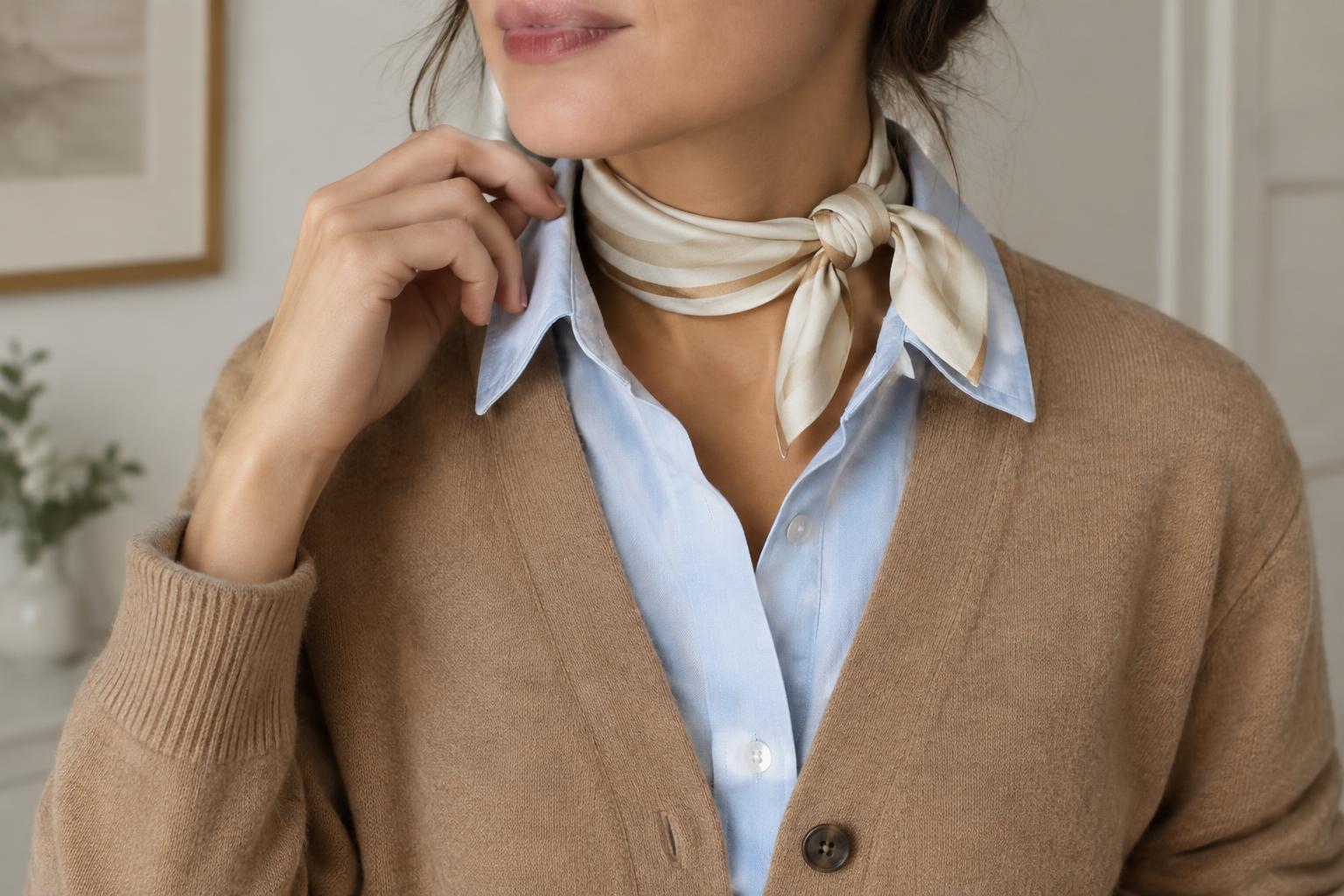
A single loose knot can look effortless, but it may shift as you move. Try a small double knot when the fabric and length allow it, tightening only enough to hold the folds together. Place it at the side of the neck for a relaxed accent or near the center for a tidier finish. The aim is a stable scarf, not a tight collar: you should be able to move and breathe comfortably.
A short square scarf can also be folded into a band and tied with a small knot at the back of the neck, leaving a smooth panel at the front. If you prefer the knot in view, wrap the band once and tie the ends toward the front, provided the scarf is long enough to do so without pulling. For a longer, lightweight scarf, a simple loop-through arrangement may hold more reliably than two freely hanging ends. Test the knot with a few head turns before leaving home; if it shifts, refold or reposition it rather than simply pulling it tighter.
Use clothing to help anchor it
The neckline beneath a scarf can make a difference. A scarf laid over a very smooth top may move more than one resting against a textured knit or tucked just inside a shirt collar. With a button-front shirt, you can place the folded scarf beneath the collar and tie it above the top button. The collar gives the scarf a boundary without requiring an extra fastening.
For a jacket or cardigan, try arranging the scarf first and then putting on the outer layer. Lapels or a partially closed front can help keep longer ends from swinging freely. Leave enough room that the fabric does not bunch or pull when you sit down. If the scarf is meant to be the visible focal point, let the outer layer frame it rather than trapping it completely.
Try gentle accessories instead of pins
A scarf ring can hold two ends together without piercing the fabric. Choose a ring with smooth edges and an opening that suits the scarf’s thickness: one that is too loose may slide, while one that is too tight may crease delicate material. Thread the ends through, position the ring, then check whether it stays put as you move. A soft, fabric-covered hair elastic can also gather ends discreetly, especially when hidden under a collar or at the back of the neck.
Avoid improvised fasteners with rough seams, exposed metal edges or a strong grip. These can snag fine weaves or leave marks. Before wearing an accessory for a full day, try it briefly in an inconspicuous part of the scarf and see how the fabric looks when released. Sometimes the simplest solution is to change the fold or knot rather than add a fastening.
Keep the finish comfortable and care for the fabric
Check the scarf in a mirror from the front and sides, then move as you normally would: turn your head, raise your arms and sit down. A secure arrangement should still feel comfortable. If a knot presses against your neck or loosens repeatedly, try a different position or a lighter wrap. A scarf does not need to stay perfectly still to look intentional; small, natural movement is part of its appeal.
After wearing, undo knots gently rather than pulling the ends through. Let the scarf rest unfolded or loosely rolled so persistent creases have less chance to form, and follow its care label for cleaning and pressing. With a fold that suits the fabric and a fastening that feels comfortable, you can enjoy the finishing touch of a neck scarf without relying on sharp pins.