Start with a clear relationship between the prints
Mixing prints is easier when you decide what connects them before you get dressed. That connection might be a shared color, a similar mood or a contrast in pattern size. A scarf with a cream background and fine blue details, for example, has an obvious link to a blue-and-cream striped shirt. The prints do not need to match exactly; they need one feature that makes their pairing look intentional.
Let one print take the lead. If your scarf has a large, colorful motif, choose a smaller or quieter pattern for the garment beside it. If the scarf has tiny, evenly spaced details, it can hold its own against broader stripes or a bold check. Leaving some solid fabric in the outfit gives the eye a place to rest. A plain coat, jacket or pair of trousers can provide that pause without making the look less interesting.
Pair a printed scarf with stripes
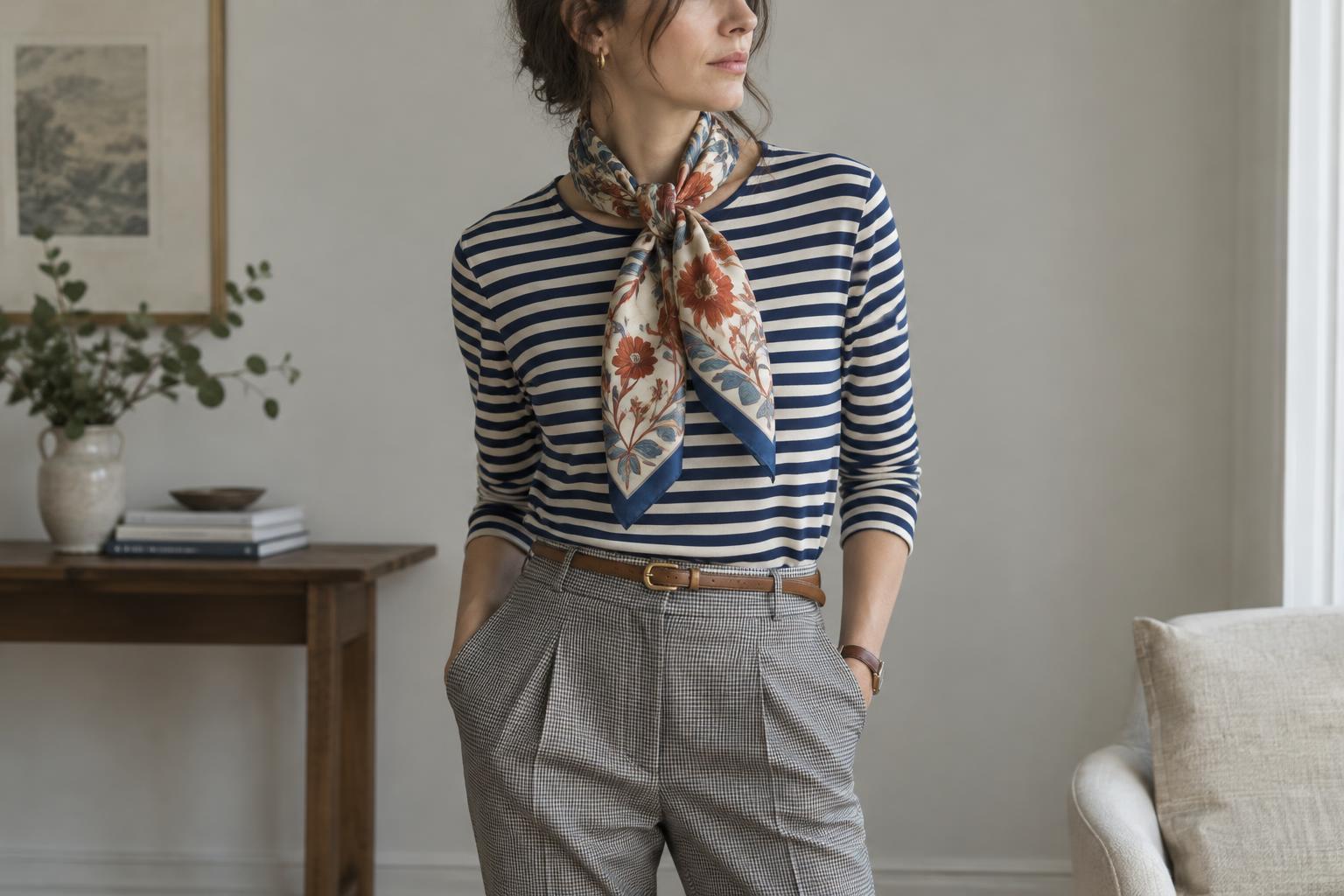
Stripes make a useful starting point because their regular rhythm contrasts with the curves or irregular shapes found in many scarf prints. Try a patterned scarf over a striped knit, then check whether one color appears in both pieces. A narrow navy stripe can sit beneath a scarf that contains a little navy, even if the scarf also introduces rust, green or pink.
Pay attention to the space between the patterns as well as the patterns themselves. Tying the scarf loosely over a crewneck brings both prints into view, while tucking it beneath a jacket shows only a smaller flash of color. If the combination feels busy, swap wide, high-contrast stripes for finer ones, or fold the scarf into a narrower band. Those small changes can make the same two pieces feel much more balanced.
Make checks feel deliberate
Checks bring another grid to the outfit, so look for a scarf that offers a different kind of movement. A softly drawn botanical, an abstract print or a loose geometric design can contrast with a crisp checked blazer. You can also mix two geometric patterns: the key is to vary their scale. A small check beside a larger scarf motif is usually easier to distinguish than two similarly sized grids competing for attention.
Check the outfit from a little distance. Up close, a scarf and checked jacket may share several appealing details; from farther away, their colors may blend into a single busy area. If that happens, create separation with a plain top between them. A scarf tied at the neck over a solid shirt gives a checked coat its own space, while still allowing both patterns to be part of the outfit.
Combine florals without making them identical
Two florals can work together when they differ in scale or drawing style. Pair a scarf with small, scattered flowers with a garment bearing larger, more open blooms. Alternatively, put a graphic floral scarf next to a soft, less defined floral print. Repeating one background color or accent shade helps link the pieces while preserving the contrast that makes the pairing interesting.
There is no need to use every color in a floral scarf elsewhere in the outfit. Choose one shade to echo and keep the remaining pieces simple. If a floral dress and scarf together feel too full, move the scarf away from the neckline: tie it to a bag handle or wear it as a narrow hair accessory. The prints still relate, but they no longer occupy the same visual space.
Adjust the outfit, not just the scarf
A pattern mix can change considerably depending on what surrounds it. Solid layers soften a combination, while patterned trousers, noticeable jewelry or a contrasting bag add more to take in. Before replacing either print, try removing one other detail. Then experiment with the scarf: spread it across the shoulders for a larger area of print, or roll and knot it close to the neck for a smaller accent.
Fabric also affects the result. A fluid silk scarf drapes differently from a structured checked jacket or a ribbed striped knit, which can give the combination welcome variety. If the scarf slips or obscures the garment pattern, try a simpler knot or secure it beneath a collar. The most useful test is practical: can you move comfortably, and can you still see what you liked about both pieces? When the answer is yes, the mix is doing its job.