Start with the shape, not the knot
A large square scarf offers more styling options than a narrow scarf, but all that fabric can gather around the neck. The easiest way to control its volume is to decide on a shape before putting it on. For a long, narrow band, fold two opposite corners toward the center, then fold inward again until the scarf is as slim as you like. Smooth each fold with your hands rather than twisting the fabric into a rope.
For a softer shape, fold the square once into a triangle. You can leave the triangle open to show more of its pattern, or fold its long edge over once or twice to shorten the point. Neither approach needs to be perfectly precise. The aim is to distribute the fabric so it lies against your clothes instead of bunching in one place.
Let the ends fall instead of wrapping repeatedly
One wrap around the neck is often enough for a large scarf. With the scarf folded into a band, place its center behind your neck and bring both ends forward. Let them hang loose over a shirt, knit or jacket, adjusting their lengths until the look feels balanced. This creates two clean vertical lines and leaves the area under your chin open.
If you want more movement, make one end slightly longer than the other and bring the longer end across your chest. Tuck it loosely under a jacket lapel or let it rest on top. You do not have to fill every bit of space at the neckline: a little visible collar, skin or shirt fabric can keep a bold print from feeling crowded.
Choose a knot that stays small
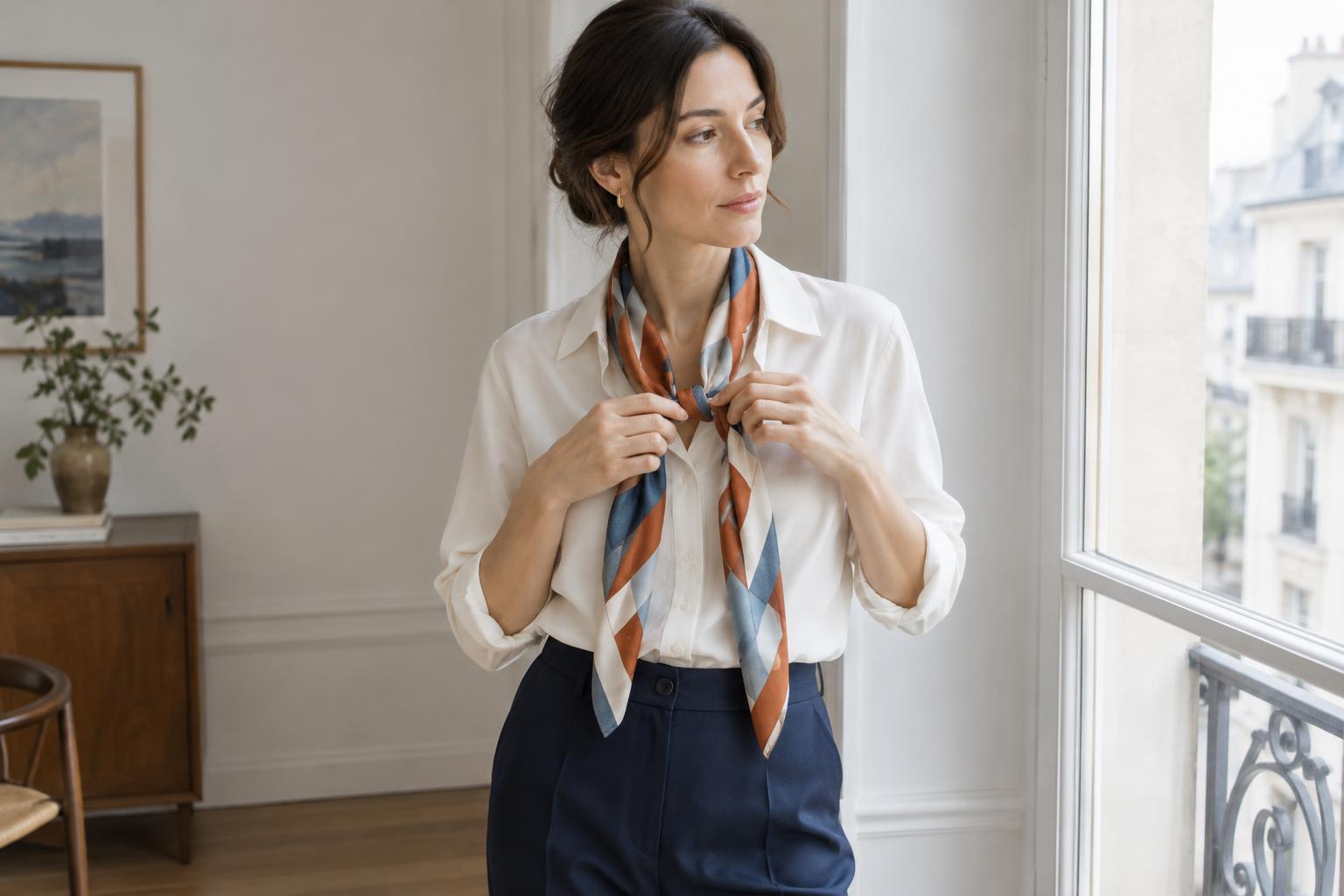
A simple single knot usually uses less space than a bow. Fold the scarf into a band, drape it around your neck and tie the ends once at the front. Move the knot a little to one side if it sits directly against a shirt placket or jacket closure. Leave the ends long rather than pulling the knot tight; they will lie flatter and be easier to adjust throughout the day.
For a discreet finish, tie a loose knot near the ends of the band and wear it lower on your chest. This keeps the scarf away from your face while still showing its color. If the knot feels heavy, undo it and refold the scarf more narrowly before trying again. Adding more turns or tucks rarely solves a volume problem.
Place the scarf where your outfit has room
Necklines, collars and outerwear change how much space a scarf has. An open jacket over a simple top gives a folded scarf room to hang without competing with a high collar. With a buttoned shirt, try wearing the scarf as a slim band beneath the collar, with the ends hanging outside the shirt. A high-neck knit may work better with the scarf worn away from the neck altogether.
You can tie a folded scarf around a bag handle for a small accent, or wear it at the waist with a simple dress or trousers that have secure belt loops. At the waist, keep the scarf relatively flat and make a small side knot. Avoid pulling delicate fabric tightly through rough hardware, which may snag it. Moving the scarf is useful when you love its pattern but do not want another layer near your face.
Balance print, fabric and the rest of the outfit
A large scarf can be the most expressive part of an otherwise quiet outfit. If its print contains several colors, try pairing it with one or two solid pieces that echo shades already in the design. This gives the scarf a clear role without requiring every accessory to match. If you want a more subdued effect, fold the scarf so only a narrow strip of the print is visible.
Fabric matters, too. A fluid scarf may settle close to the body, while a crisper one may hold a more sculptural fold. Neither needs to be forced into the same knot. Before leaving, check the scarf from the front and side, then loosen or flatten any area that sticks out more than you want. A few small adjustments are often more effective than a complicated tying method.