Start with the fold
Before tying a small square scarf, decide how much fabric you want to show. Lay the scarf flat with one corner pointing toward you. For a narrow band, fold that corner toward the center, then fold the opposite corner over it. Continue folding both sides inward until you have a strip about two fingers wide. A narrower strip makes a tidy knot; a wider one shows more of the print.
For a softer shape, fold the square in half diagonally to make a triangle. You can leave the pointed end visible at the front or roll the long edge toward the point once or twice. There is no need to make every fold exact. A little variation gives the scarf movement, while a firm initial fold helps it stay in place.
Try a simple front knot
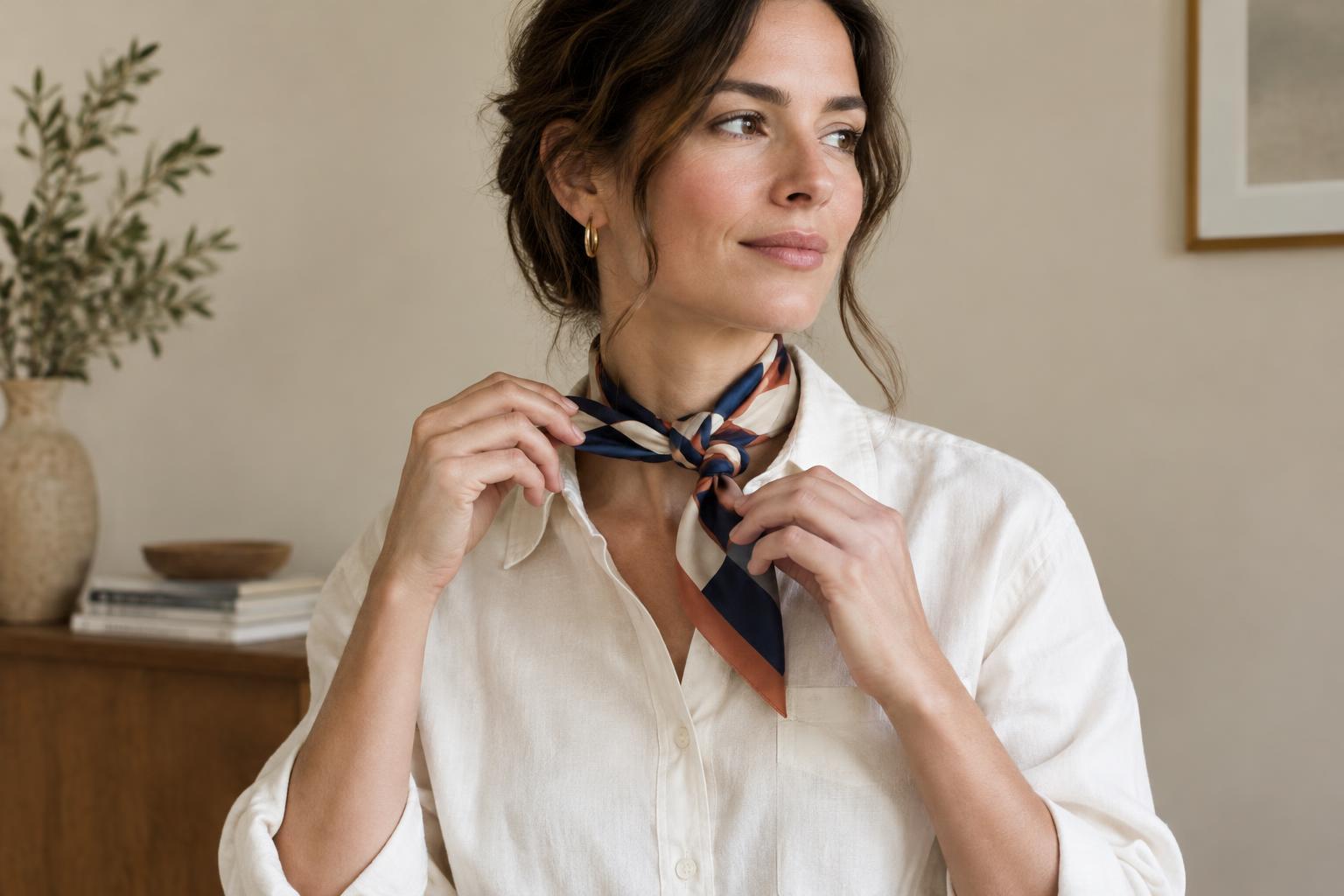
The front knot is a useful place to begin. Make a narrow band and place its middle at the back of your neck. Bring both ends forward, keeping them roughly even, then tie one loose overhand knot just below your throat. Tie a second knot if the fabric slips easily. Gently pull the ends apart to settle the knot, rather than tightening it against your neck.
Wear the ends pointing down for a neat, symmetrical look, or turn the knot slightly to one side for a more relaxed finish. If the scarf is very small, let the short ends stand out instead of trying to tuck them away. With an open collar, position the knot in the space between the collar points; with a crewneck, leave a little room between the scarf and the neckline so neither feels crowded.
Make a side knot or a small neckerchief
For a side knot, start with the same narrow band. Center it at the back of your neck, bring the ends forward, and shift them toward one side before tying a loose double knot. Turn the knot until it sits where you like it: beside the collarbone, just below the jaw, or closer to the shoulder. This tie works especially well when you want the scarf to add color without sitting in the middle of your outfit.
To make a small neckerchief, use the triangle fold instead. Place the point at the front of your neck, bring the two outer corners around the back, and tie them there if they reach comfortably. If the ends are too short, bring them forward and tie them beneath the point. Smooth the front triangle or leave it gently rumpled. The result shows more of the scarf’s pattern than a narrow band does.
Adjust the scarf to your outfit
A neck scarf is easiest to style when it has a clear role in the outfit. Against a plain shirt or knit, a patterned scarf can provide the main detail. With a printed top, consider choosing a scarf that repeats one color from the clothing, or let one piece be quieter than the other. You do not need a perfect color match; the aim is to give the eye a sense of connection.
Check the scarf from a comfortable distance after tying it. If it seems bulky, refold it more narrowly or move the knot away from a thick collar. If it disappears, loosen the fold to reveal more fabric. Small adjustments often matter more than a complicated tie. The scarf should move with you and allow you to turn your head freely.
Keep the knot comfortable and the fabric in good shape
Tie the scarf while standing in your usual posture, then check that you can slip a finger comfortably beneath it. A loose double knot generally holds better than a single knot pulled tight. If the scarf has a delicate finish, avoid fastening it with a pin or pulling hard on one corner. Retie it when needed rather than forcing a slipping knot to stay put.
At the end of the day, untie the scarf instead of pulling it over your head. Let it rest flat or hang loosely so the folds can relax. Follow its care label for cleaning, especially if it is silk or another delicate fabric. With a few easy folds and knots, the same small square can look crisp, casual, or softly draped, depending on what you are wearing.