Start with the shirt collar
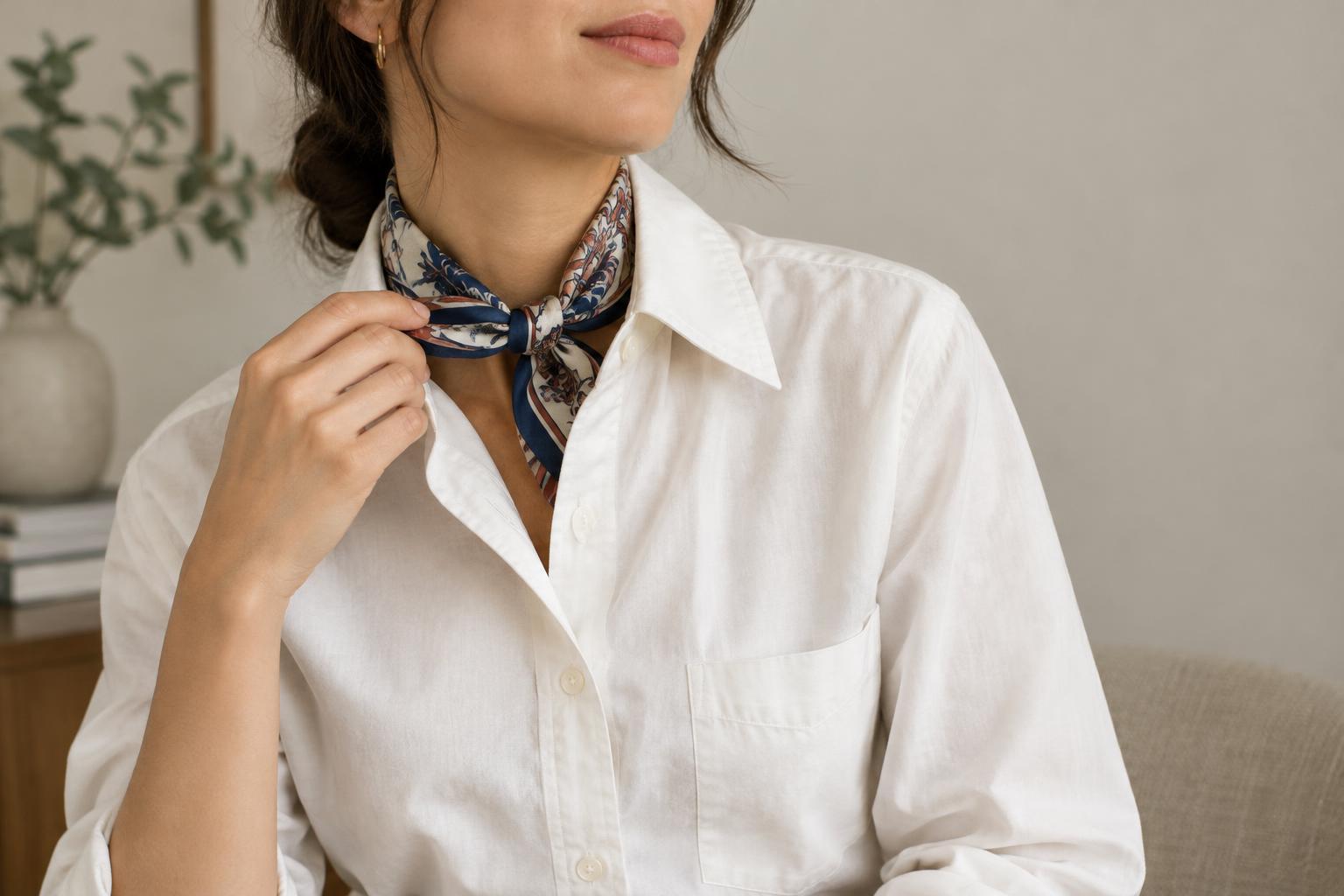
A collared shirt provides a natural frame for a scarf. Before choosing a knot, decide whether you want the scarf to sit inside that frame or outside it. A small scarf tucked beneath an open collar looks contained and tidy. A longer scarf worn over the collar makes more of a feature of the accessory. Neither approach requires a particular kind of shirt: a crisp button-down, a soft blouse, and a relaxed linen shirt can all work.
Try fastening the shirt first, then opening one or two buttons until the neckline feels comfortable. If the collar stands up firmly, keep the scarf narrow so the two do not compete for space. If the collar falls softly, you can allow a little more fabric around the neck. Check the result while standing and moving, rather than judging only a carefully arranged knot in the mirror.
Choose a tie that suits the shape
For a compact look, fold a small square scarf into a narrow band. Place its center at the front or side of your neck, cross the ends, and make a simple knot. Let the ends show above the open shirt or tuck them beneath the collar points. A side knot often feels less symmetrical and leaves the center of the shirt visible; a front knot draws attention toward the face.
A loose loop works well with a longer, slimmer scarf. Drape it around the back of your neck, bring the ends forward, and pass one end over the other without pulling tight. Leave enough room to turn your head easily. If you prefer no knot at all, lay the scarf under the collar at the back and let both ends hang down the front. This gives a plain shirt a vertical line without adding bulk at the neckline.
When wearing a buttoned-up shirt, try a narrow scarf tied beneath the collar like a soft, informal necktie. Keep the knot small enough that the collar sits flat. If the fabric bunches between the collar and the top button, loosen the shirt or choose a thinner scarf rather than forcing the arrangement.
Balance color, pattern, and volume
A scarf can introduce color without changing the rest of an outfit. With a white or pale blue shirt, you might choose one clear accent color or a print that includes a shade already present in your trousers or jacket. With a patterned shirt, a scarf in a single color is often easier to combine. Mixing prints can work too; give them different scales, such as a fine stripe on the shirt and a larger motif on the scarf, so each remains distinct.
Pay as much attention to volume as to color. A full, airy scarf can overwhelm a closely fitted collar, while a tiny square may disappear under an oversized shirt. Fold a larger scarf into a slimmer band if you want its color but not its bulk. With an open, relaxed shirt, a longer drape can echo the loose silhouette. Aim for enough contrast to make the scarf visible, while leaving the collar and your face unobstructed.
Adapt the pairing to the day
For an everyday outfit, start with a shirt you already wear comfortably, then add a scarf in a low-effort tie. A small square at the side of the neck can bring definition to a shirt and jeans. A long scarf left open can sit neatly beneath a cardigan or lightweight jacket; arrange the ends before adding the outer layer so they do not twist.
For a dressier outfit, consider a scarf with a smooth finish and a compact knot that stays close to the collar. The shirt remains the structure of the look, while the scarf supplies a point of interest. If you are wearing earrings, a necklace, or a prominent jacket lapel, you may want to keep the scarf understated. A practical test is to put on all the layers you intend to wear and see whether the neckline still has breathing room.
Comfort matters throughout the day. A knot that looks precise but slips whenever you move is not the best choice for a busy schedule. Try tying it once, walking around, and adjusting the fold if needed. A slightly relaxed scarf often looks more natural than one repeatedly tightened into place.
Keep the fabric looking its best
Different fabrics behave differently against a shirt collar. Lightweight silk or a similarly smooth fabric can be folded into a narrow shape, though it may need occasional readjustment. Cotton often holds a casual knot with less fuss. A thicker scarf adds warmth, but usually works better draped outside the collar than packed beneath it. If a shirt is made from a delicate or easily snagged material, check that the scarf's edges and any fastenings will not catch on it.
After wearing a scarf, let it air before putting it away, and follow its care label for cleaning and pressing. Avoid pulling hard on a knot, especially in delicate fabric; loosen it gently instead. The simplest pairing is often the most useful one: a collar that lies comfortably, a scarf with room to move, and a tie you can put on without a second thought.