Start with the scarf you will actually wear
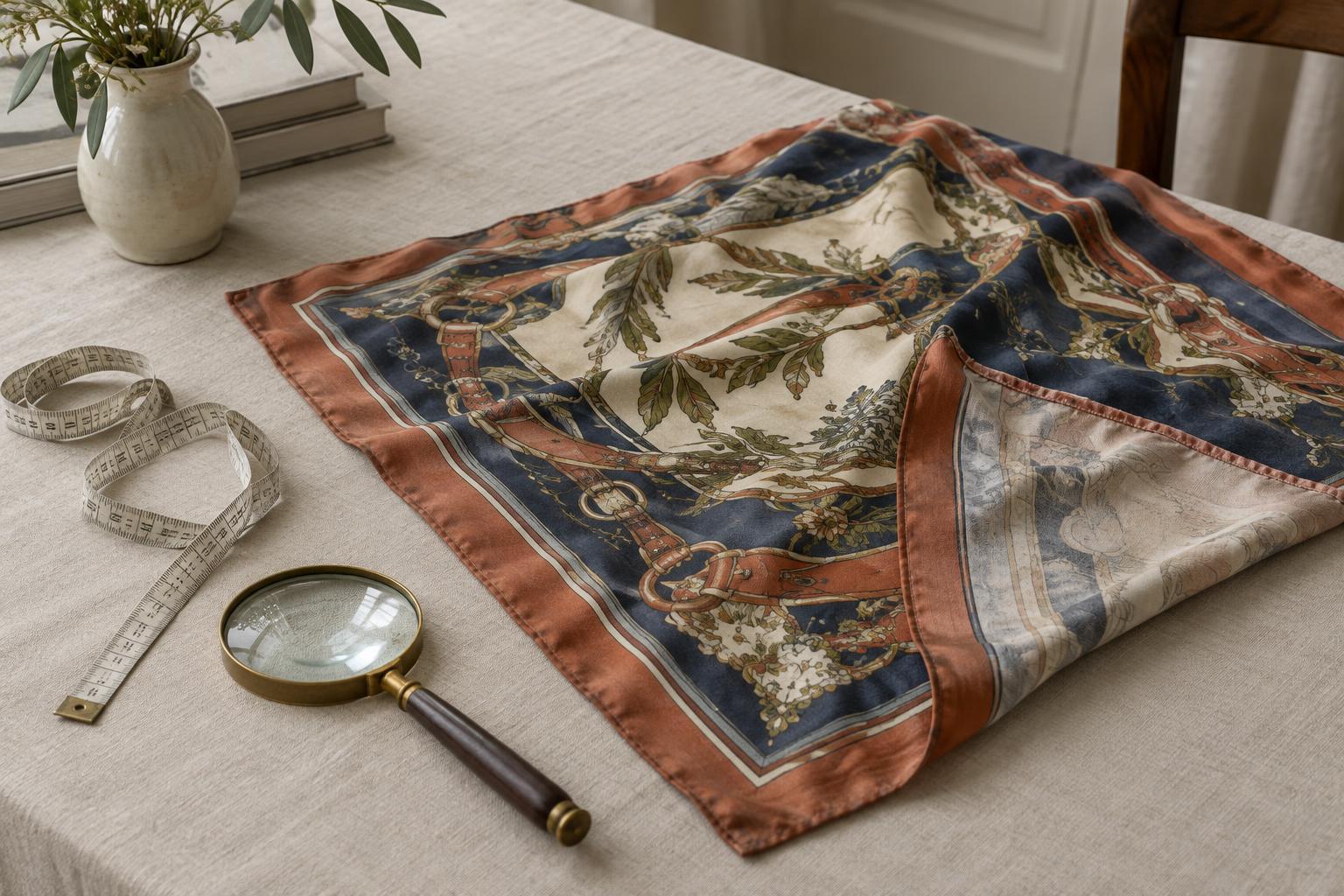
Before inspecting a secondhand silk scarf, decide what you want it to do. A small square might work well at the neck, around a ponytail or tied to a bag handle. A larger square gives you more room to drape, fold or knot it over a coat. If you already know your preferred tie, check the listed measurements against a scarf you own. Photographs can make a small scarf look generous or a large one look compact.
Consider the colors and pattern at the size you will wear them. A dramatic design spread flat may look quite different when folded into a narrow band. Look for close-up photographs as well as a full view, and notice which colors appear near the edges and corners. Those are often the parts most visible in a simple neck tie. A scarf that works with several pieces you already wear is likely to be more useful than one you admire only in its listing.
Check the fabric description, not just the shine
A glossy photograph does not establish that a scarf is silk: lighting and finishing can make several fabrics appear smooth and luminous. Read the material listing carefully and look for a clear photograph of any composition label. If the label is missing, ask the seller how they identified the fabric and weigh that answer alongside the item’s feel, drape and appearance. An absent label does not prove a scarf is unsuitable, but it does leave more uncertainty.
Silk itself comes in different weaves and finishes. A crisp twill will behave differently from a lighter, more fluid scarf, even when both are labeled silk. If you are shopping online, ask for a photograph of the scarf hanging or draped rather than lying flat. In person, gently handle an unobtrusive area if permitted; avoid pulling threads or performing a burn test. When you cannot confidently establish the fiber, decide whether you would still want the scarf at the asking price.
Inspect the whole surface and the edges
Ask to see both sides of the scarf in even light, along with close-ups of any disclosed flaws. Look particularly at the center, fold lines, pale areas and borders. Small marks may disappear into a busy print, while a faint stain can remain obvious on a plain background. Check for pulls, tiny holes, thinning, snags and areas where the color seems uneven. A stain or odor may not come out safely, so treat it as part of the scarf’s condition rather than assuming it can be fixed.
Examine the hems, too. Loose stitches, fraying or a damaged corner can affect how neatly the scarf sits when tied. A rolled edge can be attractive, but it is not, by itself, proof of a particular maker or quality. Older scarves may show softening or light wear without losing their appeal; the useful question is whether the wear is visible in your intended styling and acceptable to you. If a seller describes an item as excellent but the images are limited, request clearer photographs before committing.
Treat labels and signatures as clues, not guarantees
If the scarf is advertised under a designer’s name, examine photographs of the label, printed signature and any included packaging, but do not rely on a single detail as proof of authenticity. Labels can be removed, packaging can be separated from its original item, and designs and production details can vary. An elaborate story without clear item photographs is less useful than a straightforward description of the scarf in front of you.
Ask direct, limited questions: What are the exact dimensions? Are there stains, repairs, odors or missing labels? Are the photographs of the item being sold? A seller who supplies clear answers makes it easier to assess the purchase, even if they cannot establish every detail of its history. If a particular attribution is essential to what you are willing to pay, consider passing when the evidence remains uncertain.
Make the final decision with care in mind
Before buying, add any shipping costs and check the return terms. Compare the total with the condition, your confidence in the description and how often you expect to wear the scarf. A lower price is not much comfort if an undisclosed flaw would keep it in a drawer. Likewise, a minor imperfection may be easy to accept if it will be hidden in your favorite fold.
Once the scarf is yours, follow its care label where available. If the label is absent or the dye appears unstable, be cautious about washing it yourself; water and rubbing can set marks or change the finish of some scarves. Store it clean, dry and loosely folded or rolled, away from direct sunlight. Buying secondhand works best when you choose the actual scarf, in its actual condition, rather than an imagined version of it.